
“Land Back”
What is a Land Back process using today’s land use planning tools via a local government like Islands Trust, and how does it differ from land back through Crown-First Nation negotiation processes?

Disclaimer: This is an exploratory discussion, not a legal or formal policy interpretation. It does not represent positions, commitments, approvals, or policy directions of Islands Trust or any local trust committee. References to Indigenous perspectives reflect individual viewpoints and lived experience, not authority, consent, or positions of Cowichan Tribes, Penelakut Tribe, the Snuneymuxw First Nation, or any other First Nation.
Land Back Introduction
There is a lot of talk in our LTC meetings today arising from some profound misunderstandings about processes happening at different levels of government with regard to the return of lands to Indigenous Governing Bodies (IGBs), and concurrent acquisitions of lands by First Nations in B.C. through specific claims processes. Much of the discussion at our meetings, particularly at Gabriola LTC meetings, appears to reflect differing levels of understanding about the issues involved. In some cases, perspectives appear to be shaped by broader political viewpoints, but for some participants the concerns are rooted in uncertainty and worry that people’s private properties are at risk because of the Cowichan Tribes decision.
Now, this post is not about those decisions. I work in Islands Trust, a land use planning agency at the level of a municipal, or local government. Islands Trust does not have the power to expropriate land, nor to alter land tenure. Our obligations in regard to reconciliation are grounded in the Constitutional and legal obligation to undertake our work with a genuine intent to engage with Indigenous Governing Bodies in the Trust Area and to hear, understand and incorporate their interests and concerns into our bylaws and processes. Reconciliation is not a discretionary or goodwill-based initiative: cooperation with First Nations was written into our mandate in 2021. Islands Trust has made reconciliation commitments in regard to its work, endeavouring to undertake land use planning in a reconciliatory framework, and to reconcile the interests of Nations and Indigenous Governing Bodies with other rights holders—land title rights holders included—through land use planning in the Trust Area. This work is done on behalf of the Province, residents and all of B.C., as per the mandate.
I won’t beat the drum about how cooperation with First Nations is in our mandate, since I covered it at length in a previous post. I encourage everyone to read it to review the questions our legislative framework imposes on our work.
Two pathways for Land Back: Crown negotiation vs voluntary contribution
What I would like to primarily address in this post is the kind of voluntary return of land to an Indigenous Governing Body that can be achieved through land use planning tools, which Islands Trust already has the authority to administer. We need to understand there are two main pathways, only one of which Islands Trust or any municipal government has authority to administer: 1) the voluntary, land back pathway of privately-held lands, within the scope of Islands Trust policy making and bylaw development processes, 2) Crown-First Nation treaty or specific claims processes under the jurisdiction of the federal government.
These two types of land return are often conflated into the same initiative. Many people get them mixed up and think Islands Trust is “giving land” back to IGBs when we talk about developing regulatory tools through the OCP to protect a Heritage Conservation Area, or bylaws that trade density for a return of land to an IGB as a community amenity contribution (more on this later). Any return of federal lands to a Nation through a Crown-First Nation treaty or specific claims process is entirely outside Islands Trust authority or involvement.
I will go into some examples of Crown-First Nation agreements in a future post, but what is most relevant to our readers is the first process administered by Islands Trust, which can have a range of different expressions. This essay focuses on voluntary contributions from a land holder, developer or donor to an Indigenous Governing Body, a conservancy, or to another agency, and why it is within the jurisdiction of a local trust committee. In particular, I will focus on the land use planning tools that are returning land to Penelakut Tribe, underway on Galiano Island.
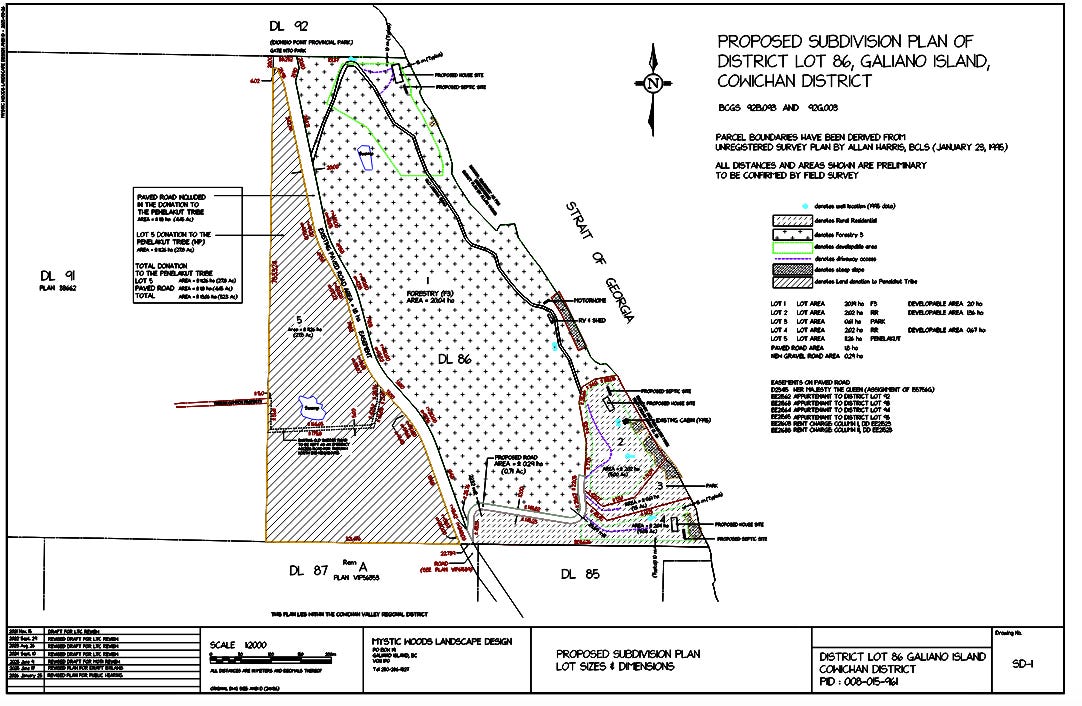
- 2026-01-25 Site Plan (updated).pdf Galiano LTC Active Applications webpage
What does “Land Back” generally mean?
Land Back is an advocacy, policy and relational position that calls on all levels of society—community, government, non-profit sector—to engage in processes of recognizing Indigenous Land rights and address the historical wrongs of dispossession through formal and voluntary means. Indigenous Peoples were removed from their traditional territories through the federal reserve system. This is a fact of history that many Canadians are still wrestling with. In large parts of Canada, some treaties with Nations were made, but in British Columbia, very few treaties were formalized by the Crown, with the exception of treaties Governor Douglas made with some Coast Salish nations, called the Douglas Treaties. This is why lands in B.C. are so often termed “stolen” in addition to “unceded”, because First Nations never gave up their sovereignty over these lands, and they were forced off them and into reserves. Therefore, the restoration of Indigenous governance over their ancestral lands, and return of lands to Indigenous peoples, is a form of restorative justice. This can take place in a number of ways.
What was meant by Islands Trust Draft Policy 3.1.3 Land Back?
The draft Islands Trust Policy Statement received first reading in July 2025 and was referred for six months to regional districts, communities, all local trust committees, Indigenous Governing Bodies and provincial agencies. It included an advisory policy 3.1.3 titled “Land Back” written thus:
Through engagement with Indigenous Governing Bodies, support opportunities to direct land to Indigenous Governing Bodies, including, but not limited to, as amenity contributions in applications seeking additional development potential.
This language gave many people pause, likely because folks didn’t understand this was a regulatory tool employed frequently in municipal governments, but less commonly in the Trust Area. The language about amenity contributions emerged from 1995, just after the Province introduced amenity zoning, and is still available in the Local Government Act under s.482. This works by establishing a base zoning density in the zoning bylaw, then specifying additional densities for specified amenities. In the Trust Area, we are most familiar with the protection of environmentally sensitive areas or high biodiversity areas being an eligible community amenity that can be exchanged for a higher density of development, and these mechanisms are outlined in some, but not all, of our OCPs.
Advisory Policies are not directives, but optional policies that a local trust committee (LTC) can incorporate into its Official Community Plan if it so chooses. Directive policies form the backbone of the Policy Statement. These are policies that “must” be considered by the Executive Committee to evaluate every bylaw and OCP from a local trust committee to confirm it aligns with the Mandate of the Trust. Advisory policies simply are there to indicate a direction that the Islands Trust may wish to go.
Proposed policy 3.1.3 was developed in response to requests from Indigenous Governing Bodies during the Policy Statement engagement process, asking that land back opportunities be considered in future planning for the Islands Trust Area. This type of voluntary land return is not related to the negotiated return of Crown lands to a First Nation but rather the contribution of private lands by willing land owners, usually in exchange for increased density or other permitted uses.
How do First Nations in the Trust Area define Land Back?
Senior Indigenous Relations Advisor for the Islands Trust, Joe Elliott, offered some helpful context. Joe is a Cowichan Tribes member with familial ties to Snuneymuxw. Speaking from his personal and professional experience, and not speaking on behalf of Islands Trust or on behalf of any First Nation, he offered this framing for why the term land back should be used, and what it implies in the drafted advisory policy 3.1.3:
“Land Back” is not a directive, but a voluntary option raised directly by First Nations and this process cannot be accomplished without willing landowners. It is not political. This term is a reconciliation-based pathway that already occurs through private transfers, conservation purchases, and treaty or specific-claim processes. Many cultural sites and sacred places exist on private lands, and some owners choose to return them to Nations for stewardship and cultural care. For these reasons, I recommend we avoid renaming or redefining the term and continue to respect the language that Nations themselves use.
According to SȾÁUTW̱ (Tsawout) First Nation:
the Land Back movement in Canada is a grassroots Indigenous-led movement that advocates for the return of Indigenous land to Indigenous peoples. It is rooted in the recognition of Indigenous land rights and seeks to address historical and ongoing injustices stemming from colonization, dispossession, and forced assimilation. The movement emphasizes the importance of land not only as a vital resource for Indigenous communities but also as a fundamental aspect of Indigenous identity, culture, and self-determination. Land Back calls for the return of lands, territories, and resources to Indigenous peoples, challenging existing colonial structures and promoting Indigenous stewardship and governance over their ancestral lands.
- from https://tsawout.ca/land-back/
“Land Back”, in the Advisory Policy example above, is an opportunity for an Indigenous Governing Body to be the receiver of a parcel of land through a transfer ratified through bylaw via the local trust committee, from a willing donor. An example of this is the return of 40 hectares to Penelakut Tribes, on Galiano island.
Rezonings on Galiano to return Land to Penelakut Tribe: a recent example
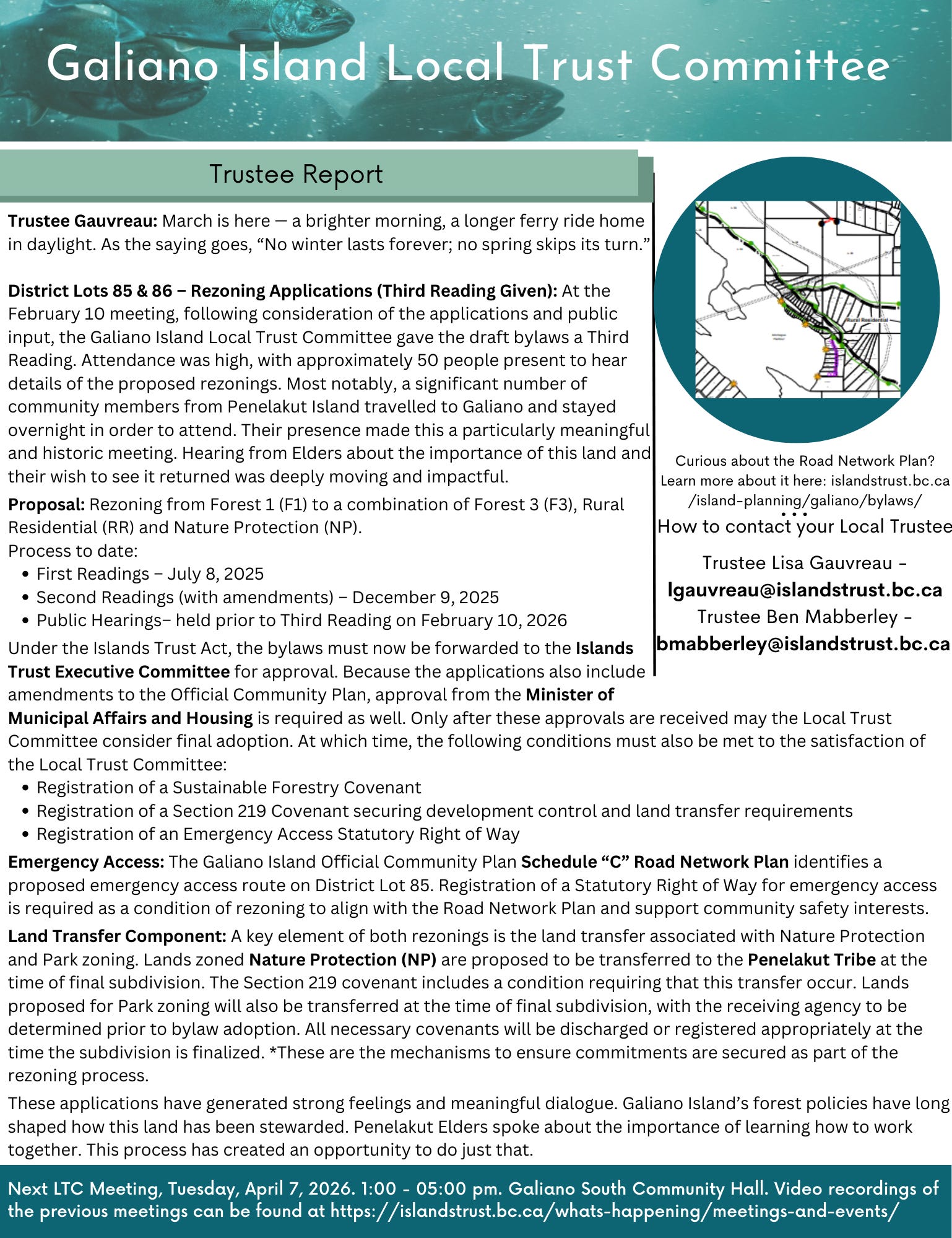
On February 10, 2026, the Galiano Local Trust Committee gave third reading to Bylaws 293, 294, 295, and 296. These were then approved by Executive Committee on February 25. Once these bylaws have been approved by the Minister of Housing and Municipal Affairs and adopted by the Local Trust Committee, a process for two subdivisions will commence that will result in a transfer of almost 40 hectares to the Penelakut Tribe. Lands zoned Nature Protection (NP) will be transferred to the Penelakut Tribe at the time of final subdivision.
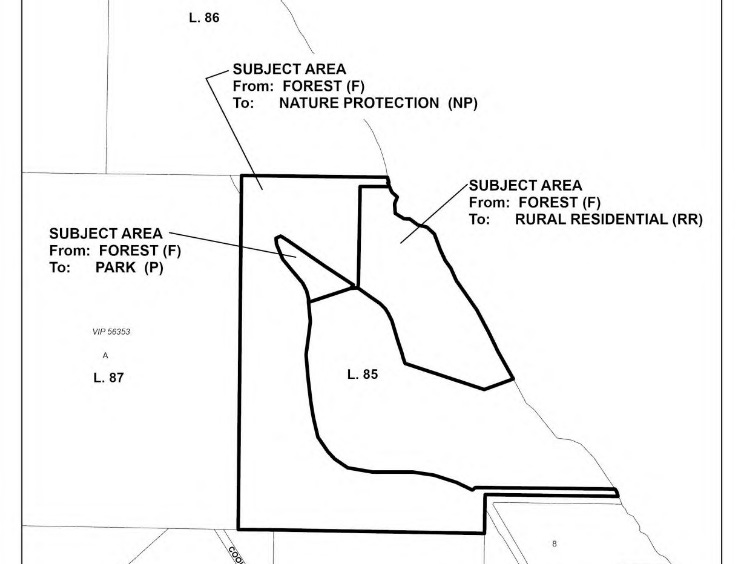
- zoning layout, 2026-02-10 Staff Report.pdf
This action is the result of the provisions of Galiano’s historical Bylaw No. 127, which stipulates that rezoning of lands designated as Forest 1 requires that 75% of the lot must be transferred to a specified recipient in order to proceed with subdivision that would create residential lots. The decision of the landowners to propose the transfer of the lands to the Penelakut Tribe, as opposed to other qualifying entities, is significant because, while the bylaw specifies that land must be transferred, it does not specify that it must be transferred to a First Nation.
Thanks to Trustee Gauvreau for sharing her report, which lays out the process:
When completed, this land transfer can be an exemplar for other such transfers. A significant portion of Galiano Island is zoned Forest 1, and, while landowners may choose to designate other recipients for future land transfers as a condition of rezoning, this transfer opens the door to further land transfers to First Nations. It was a voluntary transaction—the receiver could have been a conservancy, or land trust, or other agency, but the donor chose to transfer the land to the Penelakut Tribe.
It should be noted that this was as a fully public and transparent process, with readings, referrals and public hearings conducted as with any other proposed bylaw, and was not the result of a senior form of government undertaking Crown-First Nation negotiations.
There was considerable relationship-building between the LTC and Penelakut Tribe that led to this land transfer. It was a day of great celebration and significance, and I encourage everyone to watch the video recording of the meeting, with Chief Pam Jack and about 20 elders in attendance. Trustee Gauvreau said that she learned so much by listening to elder after elder speaking about their ties to Galiano, their home. “What a day!”
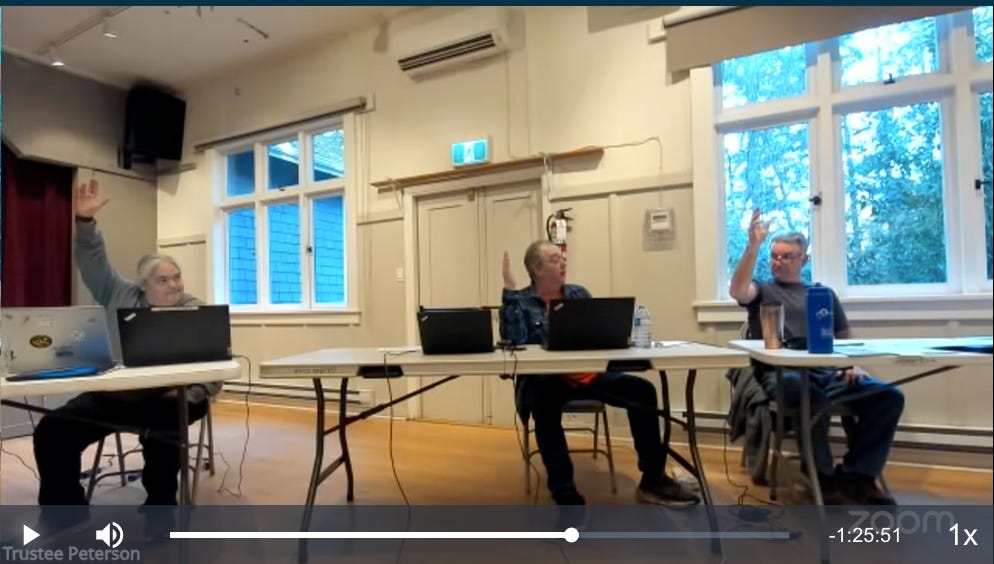
-screenshot from recording of Galiano LTC meeting, February 10, 2026
Trustee Gauvreau also noted that Bill 13 was a driver for the community. Most of the public comments about the proposed transfer were about the need to transfer the land to a body that could receive it, and before Bill 13 was enacted, it would not have been possible for an Indigenous Governing Body to receive those lands.
Bill 13 Land title and Property Law Amendment
The option for an Indigenous Governing Body to receive or hold title to lands only became reality in 2024 due to a change in legislation. The Land title and Property Law Amendment Act Bill 13 was introduced by the Honourable Murray Rankin in 2024. This amendment gives Indigenous Governing Bodies the right to hold title to land in the name of their Nation, in the province of British Columbia. This makes possible the kind of voluntary land return that can be negotiated as an amenity contribution or in a rezoning transfer.
I find it shocking that not until 2024 were Indigenous Governing Bodies “deemed to have the power and capacity of a natural person of full capacity in acquiring and disposing of land despite a stipulation, restriction or qualification expressed or imposed in any other Act or law, or in any other document.” (s.365.3)
Community Amenity Contributions through rezoning
It is quite common for developers seeking additional development potential through a rezoning, usually with the intention to subdivide their land into more lots to sell, to come up with “a gift” in the form of an amenity to the community. This is considered an inducement to the community as a way to sweeten the deal, not a guarantee for development rights. This amenity must be a public asset to the community, and, in the case of Islands Trust, it must “enhance the preservation and protection of the environment, natural amenities, resources and/or community character”.
Community Amenity Contributions have been the practice of many local governments over the past thirty years. Essentially it is an indication of what needs to be provided to get community support for a rezoning. It is voluntary, meaning the developer does not have to pay it, but then also risks not getting the zoning.
City of Nanaimo’s Community Amenity Contribution Policy defines community amenity contributions as “a tangible capital asset that is a public facility, work or service that provides an advantage or benefit to the community”.
Islands Trust policy 5.4.3 describes the purpose of Amenity Bonus Tools: to provide an opportunity for local communities to obtain “amenities” in return for permitting increase in the density of development”. Note that the identification of “amenities” that are required or considered desirable in the area covered by the plan is entirely discretionary to the LTC, as “there is no statutory definition of “amenities”.
The path to returning lands to an Indigenous Governing Body through a rezoning proposal is formalized through a government with authority over land use planning, such as Islands Trust. Islands Trust cannot compel or require a land transfer. It may, where permitted by process, consider rezoning application that propose voluntary amenity contributions, subject to public process and decision–making.
Advisory policy 3.1.3 points to the option to put policies into a Community’s Plan, such as a density transfer policy, that will allow a developer or land holder wishing to negotiate a density benefit (ie. subdivide a parcel and gain x # more densities to sell) to gift an amenity in the form of lands to an Indigenous Governing Body. As in the Galiano LTC-Penelakut Tribe case, a density transfer policy in their OCP directed the action such as “75% of the lot must be transferred to a specified recipient”. When the landowner made their application, bylaws were drafted for that purpose, which then went through a long public process, including public hearings, etc. With this kind of supportive policy in an OCP, an Indigenous Governing Body might then receive a benefit in a return of land, in exchange for the developer gaining additional densities, a benefit that historically has only been realized for the non-Indigenous community.
Local trust committees can continue to establish community amenities in OCPs as guides to people proposing rezonings. For example, an OCP density transfer policies could stipulate the LTC would consider X densities in this location for the donation of Y hectares land for conservation (for example) of land in another specified area. Many LTCs have these kinds of policies in their OCPs, and they are still valid.
Community Amenity Contribution - a Gabriola Case
In 2005, the Gabriola community benefited with a community amenity that became the 707 Park. This was the result of a density transfer that added 35 densities to a developer’s lands, in an area they termed the Legends. Islands Trust negotiated the density transfer through the development of Bylaws 235 and 236 in 2005, to allocate a maximum of 49 lots to the developer’s receiver lands.
Previously-logged forest land in the centre of the island (the donor lands) were rezoned Wilderness Recreation and the Regional District of Nanaimo took on responsibility to manage the park of approximately 707 acres (hence the name). The developer actualized 35/49 densities in two phases of subdivision over the last 20 years and is applying to Ministry of Transportation and Transit to subdivide the final 14 lots in a third phase of development.
The 707 density transfer is an example of an amenity contribution in which a community realizes a benefit, and the developer achieves extra densities for development. Until Bill 13 was passed, an Indigenous Governing Body could not have been the recipient of those lands, as the Gabriola community did, in 2005.
Community initiated Return of Lands
A final example of Land Back voluntary contribution was recently completed on Salt Spring Island. A campaign in summer 2025 raised $600,000 to cover costs of the SȾÁUTW̱ (Tsawout) First Nation’s purchase of a 2.17-acre parcel of land on the south end of Salt Spring. Lot A is adjacent to their existing 50-acre reserve on Fulford Harbour and connects to existing services.
The Salt Spring Island Foundation Land Back campaign was ultimately successful. The SȾÁUTW̱ First Nation is currently developing a Land Use Plan for all its lands, including the 99-acre parcel the Nation recently purchased adjacent to its main village on the Saanich Peninsula. The future use of Lot A will be determined in that process. Details of the campaign and maps showing the parcel, the existing 50-acre SȾÁUTW̱ reserve and the 400-acre Reginald Hill Nature Reserve can be viewed here and full campaign brochure here.
Return of Federal Lands through Crown-First Nation treaty or specific claim processes
As noted earlier, Islands Trust is not a party to Crown–First Nation negotiations, and has no role in those decisions, and does not have any knowledge of the status of current treaty or specific claims negotiations. In a future post I will detail some of the specific claims happening recently which resulted in land being transferred to the Snuneymuxw First Nation.
Conclusion
Through active participation by communities, governments, and individuals, Indigenous governance and Land Back can be supported in a number of ways. Land Back can encompass both voluntary contributions by willing landholders that are structured through bylaws developed in a public process, supported by policies in a community’s OCP, or happen through formal negotiations for the return of federal lands through the Crown-First Nation treaty or specific claims processes. True reconciliation is grounded in constitutional and legal obligations, not a discretionary or goodwill-based initiative. Embracing these multiple pathways not only addresses historical injustices but also reinforces the fundamental role of land in Indigenous identity and culture.
Thank you to everyone who reviewed and vetted this article: staff Joe Elliott, Jason Youmans, and trustees Gauvreau, Patrick and Peterson. If there are any issues with clarity or accuracy, I welcome your feedback.
As always, thanks for reading, and see you next Sunday,
Tobi
Thank you, Tobi, for explaining this. Great to get the examples too.
Very well written. Thank you for continuing to educate/raise awareness through your blog.